Champion Industrial
  • Services
        • HVAC
          • Equipment
          • Ductwork & Insulation
          • Building Automation
          • HVAC Replacement
          • Cold Storage
        • Plumbing & Pipefitting
          • Plumbing & Fixtures
          • Process & Power Piping
          • Utility Piping
          • Jetting and Snaking
        • Metal Fabrication
          • Custom Metal Fabrication
          • Conveyors
          • Platforms
          • Tank Fabrication
          • Millwrighting
        • Maintenance
          • Preventative Maintenance
          • Emergency Repair
  • About Us
    • Leadership Team
    • Partners
    • Areas We Serve
    • Careers
    • Blog
  • Contact
  • 209.524.6601
  • Menu Menu

What Is Process Piping and How Is It Used in Commercial Food and Beverage?

In the commercial, industrial, and manufacturing sectors, process piping is important. In this article, we familiarize you with essential aspects of process piping, learn how it differs from traditional plumbing, and delve into its contributions across food and beverage production.

The Basics of Process Piping

Let’s start with the basics of process piping:

What Is Process Piping?

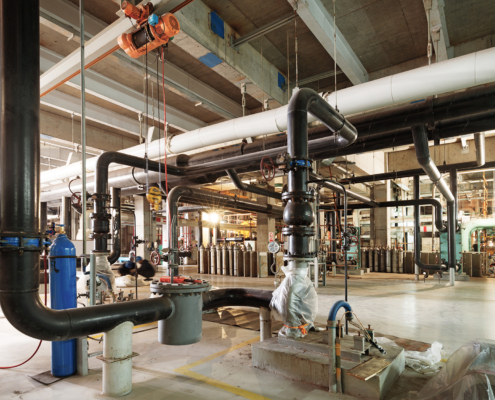
Process piping refers to the pipes, valves, fittings, and other components used to transport fluids in industrial facilities. Unlike plumbing systems in residential or commercial buildings, process piping is designed for conveying fluids at high temperatures and pressures. Process piping is a key component of many manufacturing operations, particularly in the chemical, oil and gas, food and beverage, and pharmaceutical industries.

Process piping systems must be carefully engineered to handle hazardous, volatile, or unsanitary fluids. Components are typically made from stainless steel or alloys to withstand corrosion. Valves and pumps regulate flow rates, while insulation maintains temperatures. Proper slope, support, and layout prevent buildup and clogging. Advanced materials allow process piping to meet rigorous standards.

Distinguishing Process Piping from Plumbing

While plumbing and process piping both convey liquids, they serve very different purposes. Plumbing handles safe drinking water, drainage, and sewage in homes, schools, and offices. It operates at low pressures and temperatures. Process piping manages industrial liquids and gases at extreme heat, flow, and pressure.

Process piping must withstand caustic acids, volatile solvents, or sanitizing agents. Piping contains specialized materials and components not found in plumbing systems. The design requirements also differ significantly, as process piping aims for optimal flow rates, heat transfer, and energy efficiency in production processes.

Essential Components of a Process Piping System

A process piping system contains many interconnected components working together:

  • Pipes and tubes transport the process fluid. Stainless steel is commonly used, but other alloys can also resist high temperatures and corrosion.
  • Pipe fittings like elbows, tees, and reducers join pipe sections and alter direction and flow.
  • Valves control flow rates and pressure.
  • Pumps boost and regulate fluid flow.
  • Control valves finetune flow.
  • Strainers filter out debris.
  • Steam traps remove condensate without wasting steam.
  • Instruments monitor pressure, temperature, flow, and more.
  • Insulation maintains temperature.
  • Supports and hangers hold piping in place and allow expansion and contraction.
  • Specialty components perform specific functions. The layout and slope avoid buildup and allow drainage.
  • Access ports facilitate inspection and cleaning.

Key Roles of Process Piping in the Food and Beverage Sector

Now that you have a clear understanding of what process piping is and its components, let’s examine how it’s used in the food and beverage industry:

  • Food Product Transfers

    Process piping transfers ingredients, batters, sauces, and other food products between vessels and processing equipment. For example, dough and batter must flow without excessive shearing or texture disruption and leavening. Viscous fluids like sauces, syrups, and glazes require slower laminar flows.

    Piping systems maintain product integrity during transfers between mixing, cooking, forming, extruding, fermenting, and packaging equipment. Layouts ensure proper sequencing and merging of ingredients. Slopes facilitate drainage between batches.

  • Heat Transfer and Pasteurization

    Process piping circulates heating media like steam, hot water, and thermal oils through jacketed kettles, ovens, and holding tubes to heat food products. It also cools food by circulating chilled media. Careful temperature control prevents overcooking or damage to the product.

    For products like milk, juices, sauces, soups, and egg mixes, process piping directs the product through heat exchangers or holding tubes for pasteurization. Precise thermal processing destroys pathogens while maintaining quality.

  • Clean-in-Place (CIP) Systems

    Automated CIP systems use process piping to circulate cleaning and sanitizing solutions through equipment like tanks, pipes, and fillers. Spray balls distribute chemicals throughout the system to remove soil and disinfect all surfaces the product comes in contact with. This improves food safety and reduces manual cleaning labor.

    CIP process piping has self-draining slopes, isolation valves, and access points for inspection. The cleaning sequences are programmed into the CIP control system. Data can validate the efficacy of the CIP process.

  • Conveying and Mixing

    Positive displacement pumps convey delicate ingredients like meat or fruit through process piping without damage. Dry ingredients flow through pneumatic conveying lines.

    Inline mixers combine ingredients directly in process pipes to hydrate powders, blend syrups, or emulsify fats. Static mixers have no moving parts. Dynamic mixers contain rotors to homogenize components.

  • Bottling and Packaging

    Beverages, sauces, condiments, and other liquid products flow through process piping to fillers, which accurately portion containers. Careful control prevents foaming, aeration, or agitation.
    Process piping also channels food items into form-fill-seal or other packaging machines. Precise distribution controls product placement and weight in pouches, trays, or cartons. The system may dose layers or add sauce, cheese, or inserts.

    In summary, process piping is vital for heating, cooling, conveying, mixing, cleaning, filling, and more. Careful engineering and integration with other equipment enables safe, high-quality food production.

Ready to ensure efficiency and sanitation with a new process piping system? Champion Industrial customizes systems that deliver these benefits and more.

Learn More

Fabrication and Installation of Process Piping Systems

From food processing plants to pharmaceutical production, process piping is used to safely transport liquids, gases, slurries, and powders from one point to another. The fabrication and installation of these critical systems requires expertise, planning, and precision.

The Fabrication Process

The fabrication of process piping begins with the design drawings and material specifications provided by the engineering team. Piping components like straight pipes, elbows, tees, flanges, valves, and filters are brought into the fabrication shop. The lines are customized, cut to length, deburred, beveled, cleaned, and stacked according to the spool drawings.

Fitters assemble the piping spools by welding the pipes, fittings, and other components per the isometrics. The welds, materials, and fabrication process must conform to applicable codes and standards like ASME B31.3, ANSI B16.5, and AWS D1.1. Heat numbers are recorded, and material test reports are filed for traceability. Once assembled, the spools are checked against the isometrics and engineering models to ensure fit-up and dimensional accuracy.

The spools are then sent for visual, dye penetrate, radiographic, or ultrasonic inspections based on code requirements. Insulation and painting are applied before the spools are shipped to the installation site. Proper handling, loading, and transportation procedures are followed to prevent damage en route.

The Installation Process

At the plant site, the piping spools are unloaded and stocked according to area layouts. The civil and structural works would have been completed by this stage and the piping supports, pipe racks, and hangers installed. The prefabricated piping spools are lifted using cranes or rigging equipment and aligned with connecting piping or equipment nozzles.

Fit-up gaps are measured, alignment corrections are made, and the joints are tack-welded. Permanent shop welds may also be completed at this stage if partial welds were done during fabrication for transportation purposes. Flange bolts are then tightened to connect equipment like valves, strainers, and pumps.

Supports are adjusted, expansion joints are aligned, and sloping drain lines are verified using tubing levels. Once aligned, the piping systems are permanently welded according to code requirements. Welds are tested as needed, followed by hydro testing, which involves filling the pipes with water pressurized to 1.5 times the design rating.

The piping systems are then flushed, cleaned, and dried before insulation. After insulation and final supports are installed, the completed piping systems undergo leak testing using air or the actual process medium. Any leaks found are repaired before handover for pre-commissioning.

The Importance of Working With a Certified Provider

Given the hazards of piping system failure, certified service providers are critical. They should have qualified personnel, ASME code stamps, in-house spool fabrication, and experienced welders certified for all necessary methods and materials. The provider should have accredited testing and inspection equipment and robust QA processes compliant with ASME B31.3 and local codes. Their installation crews need training and expertise in critical lifts, rigging, alignment, and setting prefabricated modules for high-temperature process piping.

Turn to Champion Industrial for All of Your Process Piping Needs

For over 90 years, Champion Industrial has been the go-to HVAC, metal fabrication, plumbing and pipefitting, and maintenance provider for businesses throughout Northern and Central California. As members of the National Certified Pipe Welding Bureau and Mechanical Contractors Association of America, our certified welders and fabrication experts craft powerful and efficient process piping systems based on your needs. Contact us today to discuss your process piping project and receive a free quote.

Share This Post

  • Share on Facebook
  • Share on X
  • Share on LinkedIn
  • Share on Reddit
  • Share by Mail

Related Postings

How Plumbing Preventive Maintenance Saves Time and Money in Industrial Facilities

How Plumbing Preventive Maintenance Saves Time and Money in Industrial Facilities

Preventative Maintenance
Read more
December 29, 2025
https://www.championindustrial.com/wp-content/uploads/2025/12/image1.jpg 1250 2000 Abstrakt Marketing /wp-content/uploads/2023/05/champion-logo.png Abstrakt Marketing2025-12-29 11:21:192026-05-13 11:42:50How Plumbing Preventive Maintenance Saves Time and Money in Industrial Facilities
Side view of the gray commercial central conditioner with DX coil

Preventing Fall HVAC Issues in California’s Commercial Buildings

Preventative Maintenance, Seasonal HVAC
Read more
July 11, 2025
https://www.championindustrial.com/wp-content/uploads/2025/07/Side-view-of-the-gray-commercial-central-conditioner-with-DX-coil.jpg 1250 2000 Abstrakt Marketing /wp-content/uploads/2023/05/champion-logo.png Abstrakt Marketing2025-07-11 12:10:212026-05-13 11:42:51Preventing Fall HVAC Issues in California’s Commercial Buildings

The Cost of Deferred HVAC Maintenance in the Fall: What California Businesses Risk

Preventative Maintenance, Seasonal HVAC
Read more
July 3, 2025
https://www.championindustrial.com/wp-content/uploads/2025/07/Close-up-view-of-HVAC-technician-performing-maintenance-on-air-conditioning-system-in-commercial-building-environment.jpg 1250 2000 Abstrakt Marketing /wp-content/uploads/2023/05/champion-logo.png Abstrakt Marketing2025-07-03 05:41:512026-05-13 11:42:51The Cost of Deferred HVAC Maintenance in the Fall: What California Businesses Risk

Categories

  • Case Study
  • HVAC
  • HVAC Maintenance (Commercial)
  • Maintenance
  • Metal Fabrication
  • Plumbing
  • Plumbing Maintenance
  • Preventative Maintenance
  • Process and Power Piping
  • Seasonal HVAC

Contact Us

"*" indicates required fields

This field is for validation purposes and should be left unchanged.

About Us

Champion Industrial has over nine decades of experience in completing assorted projects in various industries, and our track record speaks for itself. Our 67,000-square-foot fabrication facility, conveniently situated in Modesto, CA, is a centralized hub for HVAC systems, sheet metal, process piping, and industrial fabrication operations.

What We Do

HVAC Solutions

Plumbing and Pipefitting

Metal Fabrication

Maintenance

Emergency Repairs

Contact Us

Main Office: 209-524-6601
Service Line: 209-526-4900

[email protected]

1420 Coldwell Ave.
Modesto, CA 95350

Website by Abstrakt Marketing Group ©
  • Link to LinkedIn
  • Privacy Policy
  • Sitemap
Scroll to top Scroll to top Scroll to top

This site uses cookies. By continuing to browse the site, you are agreeing to our use of cookies.

AcceptLearn more

Cookie and Privacy Settings


How we use cookies

We may request cookies to be set on your device. We use cookies to let us know when you visit our websites, how you interact with us, to enrich your user experience, and to customize your relationship with our website.

Click on the different category headings to find out more. You can also change some of your preferences. Note that blocking some types of cookies may impact your experience on our websites and the services we are able to offer.

Essential Website Cookies

These cookies are strictly necessary to provide you with services available through our website and to use some of its features.

Because these cookies are strictly necessary to deliver the website, refusing them will have impact how our site functions. You always can block or delete cookies by changing your browser settings and force blocking all cookies on this website. But this will always prompt you to accept/refuse cookies when revisiting our site.

We fully respect if you want to refuse cookies but to avoid asking you again and again kindly allow us to store a cookie for that. You are free to opt out any time or opt in for other cookies to get a better experience. If you refuse cookies we will remove all set cookies in our domain.

We provide you with a list of stored cookies on your computer in our domain so you can check what we stored. Due to security reasons we are not able to show or modify cookies from other domains. You can check these in your browser security settings.

Other external services

We also use different external services like Google Webfonts, Google Maps, and external Video providers. Since these providers may collect personal data like your IP address we allow you to block them here. Please be aware that this might heavily reduce the functionality and appearance of our site. Changes will take effect once you reload the page.

Google Webfont Settings:

Google Map Settings:

Google reCaptcha Settings:

Vimeo and Youtube video embeds:

Accept settingsHide notification only